Something Was Funnier on Tape: The Lost Comedy of Watching Sitcoms on VHS
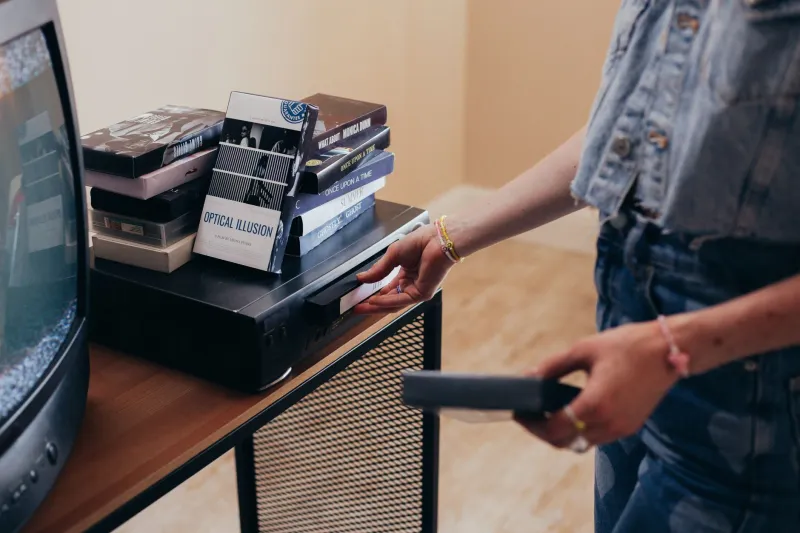
Pull out an old tape of Seinfeld. Not a rip on YouTube, not the Peacock stream — an actual cassette, the kind you recorded off NBC on a Thursday night in 1994, complete with a Wendy's commercial wedged between acts two and three. Hit play. Now tell me that laugh track doesn't hit a little different.
It does. And you're not imagining it.
There's something genuinely strange happening when you revisit sitcom comedy through VHS. The jokes feel looser, the timing feels warmer, and the laugh track — that thing modern critics love to mock — somehow sounds less canned and more like a room full of real people who actually found something funny. It's not just nostalgia doing the heavy lifting here. The medium itself was shaping the comedy in ways we never stopped to appreciate while it was happening.
The Tape Had Its Own Rhythm
Digital streaming delivers comedy at a frictionless clip. One episode ends and the next one starts before you've even finished laughing. That relentlessness isn't neutral — it actually flattens the experience. Comedy needs breath. It needs the equivalent of a pause between punchlines, a moment where the joke can settle before the next one lands.
VHS gave you that, whether you wanted it or not. Commercials interrupted the flow, sure, but they also functioned like a reset button between scenes. You'd come back from a Taco Bell ad with fresh eyes. The episode felt like it had chapters. And when you were watching a tape you'd recorded yourself, those commercial breaks were often clipped or half-edited, creating these odd little jump cuts that somehow made the comedy feel even more alive — like you were watching something slightly contraband, a private cut just for you.
There was also the matter of physical commitment. You chose that tape. You walked to the shelf, pulled it out, found the right spot, and pressed play. By the time the theme song started, you were ready to laugh. Streaming doesn't ask that of you. It just starts. And something about that effortlessness makes the whole thing feel disposable before it even begins.
What the Laugh Track Actually Did
The laugh track has been dismissed for decades as a cheap manipulation tool — a way to tell dumb viewers when something was funny. And look, that criticism isn't entirely wrong. But the laugh track was doing something more interesting than it got credit for, and VHS let you feel it in a way streaming doesn't.
On tape, especially on a recorded-off-TV copy, the laugh track had texture. It came through slightly compressed, slightly warm, filtered through whatever your TV's speakers could manage. It felt like it was coming from a room adjacent to yours. Compare that to a clean HD stream where every audio element is crisp and separated — suddenly the laugh track sounds exactly like what it is: a sound effect layered over dialogue. The artifice becomes obvious.
On VHS, the whole thing was a little muddy, a little imprecise, and that imprecision made the laugh track feel more organic. You weren't hearing a production element. You were hearing an audience. It's the same reason vinyl records feel warmer than MP3s — not because they're technically superior, but because the slight degradation mimics something human.
Rewinding to the Good Part
Here's something streaming has genuinely never replicated: the rewind.
Not the ten-second-back button. The actual rewind. The deliberate, slightly effortful act of backing up a tape to catch a joke again. When you rewound to replay a bit — George Costanza's voice cracking during an argument, or Frasier delivering a perfectly timed insult — you were making a conscious choice to honor the comedy. You were saying, that was worth doing again.
Streaming's back-button is too easy to carry any of that weight. You tap it without thinking. The VHS rewind was a small ceremony. And when the tape caught up and the joke played again, it was funnier. Not because the joke changed, but because you'd invested something in it.
Collectors who still watch sitcom tapes talk about this constantly. There's a guy in a Facebook group for vintage TV recordings who claims he's rewound the same Cheers cold open — the one where Sam and Diane argue about a dictionary — no fewer than forty times across thirty years. He says it gets funnier every time. He's probably right, and the tape probably has something to do with it.
The Commercial Break as Comedy Amplifier
Something else worth acknowledging: the commercials on those old tapes were often funnier than we gave them credit for. Not funny in an intentional way, but funny in the way that dated things become funny — the regional car dealership spots, the fast food ads with their aggressive jingles, the PSAs that now look like parody.
That accidental comedy surrounding the intentional comedy created a kind of layered experience. You'd laugh at a Fresh Prince joke, sit through an absurd 1992 Burger King ad, and come back to the show already warmed up from laughing at something completely unrelated. The whole tape was funny. The sitcom was just the anchor.
Streaming gives you nothing like that. You get a pre-roll ad for something algorithmic and joyless, or you pay to skip it entirely. Either way, you lose the weird ambient comedy that old broadcast recordings carried as a side effect of their era.
Why Collectors Keep the Tapes
Ask anyone who still holds onto their old sitcom recordings and they'll give you some version of the same answer: it's not just the show, it's the whole artifact. The tape is a time capsule of a specific night, a specific season, a specific version of American life. The comedy is embedded in all of that context.
When you stream Seinfeld today, you're watching a cleaned-up, decontextualized version of a show that originally existed inside a particular cultural moment. When you watch it on a tape recorded in 1996, you're watching it the way it was actually experienced — surrounded by evidence of its own era, slightly degraded, slightly imperfect, and somehow more real because of it.
The laugh track sounds right. The timing feels natural. The jokes land the way they were supposed to land.
Maybe it's pure nostalgia. Maybe it's the placebo effect of holding a physical object. But maybe — just maybe — VHS was doing something for comedy that we didn't fully understand until we lost it. The tape wasn't just storing the show. It was completing it.