Stopped Here for a Reason: The Hidden Language of Where Your VHS Tape Was Left
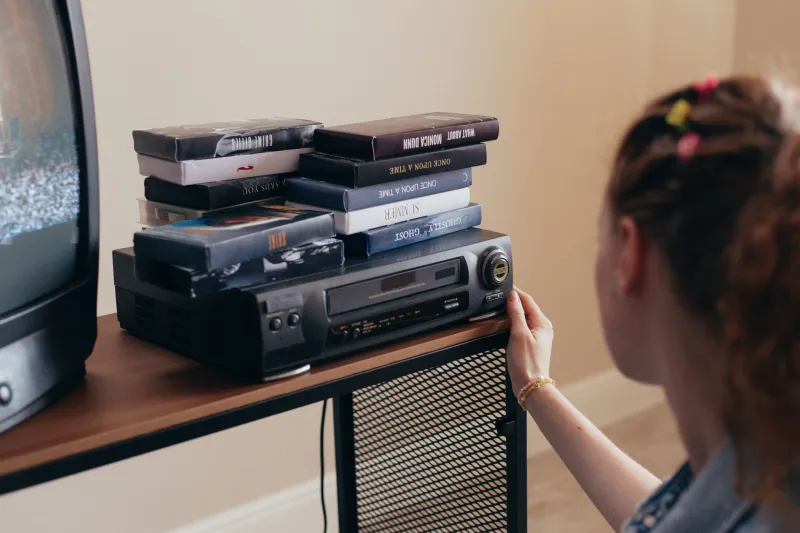
There's a specific kind of discovery that only VHS collectors and family archivists ever get to experience. You pick up an old tape — maybe it's labeled in your mom's handwriting, maybe it's a rental that never made it back to Blockbuster — and you slide it into the deck. The machine whirs. The heads engage. And instead of starting at the beginning, the picture snaps on somewhere in the middle. A wedding toast. A cartoon theme song. The final ten minutes of a movie somebody clearly loved.
Somebody stopped it there. On purpose, or maybe not. But either way, they left a mark.
That's the thing about VHS that nobody talks about enough: the tape's physical position was a form of communication. Unconscious, maybe. Accidental, sometimes. But real.
The Bookmark Nobody Meant to Leave
Digital media doesn't do this. A streaming service picks up where you left off, sure, but that's a function — a convenience feature. It doesn't carry weight. When you close a Netflix tab, you're not leaving a trace of yourself for anyone else to find.
But a VHS tape stopped at the 47-minute mark? That's a fossil. That's evidence.
Collectors who deal in secondhand tapes — picked up at estate sales, thrift stores, or inherited from relatives — will tell you that the resting position of a tape is often the first thing they check. Not the label. Not the condition of the shell. Where did it stop? What was the last thing this tape was showing when someone pressed pause or just hit eject and walked away?
Sometimes it's mundane. Sometimes it's heartbreaking. A tape found in a grandmother's house, stopped right at the moment a long-dead grandfather is laughing at something off-camera. Nobody rewound it. Nobody wanted to.
Rewinding as Ritual
There's another layer to this, though — the intentional rewind. The deliberate act of spinning the tape back to a specific spot before putting it away.
Anyone who grew up in a house with a shared VCR knows this behavior intimately, even if they never named it. You'd finish watching something, and instead of rewinding all the way, you'd stop at your part. The part you'd been rewinding to for weeks. The scene that hit different every single time.
For some people it was a favorite movie moment — the chest-bump scene in Top Gun, the "As you wish" line from The Princess Bride, the jump scare in Poltergeist that you kept testing yourself against. For others it was something more personal: a home video clip of a birthday party, a snippet of a TV appearance someone taped off the news, a few seconds of footage of somebody who wasn't around anymore.
You rewound to it. You watched it. You rewound to it again. And eventually the tape wore thin right there, at that exact spot. The picture got a little snowy. The tracking got shaky. The tape itself started to confess what you'd been doing.
What Worn Tape Tells You
VHS tape degrades unevenly. That's one of the more poetic facts about the format. Unlike digital media, which fails all at once, magnetic tape wears down gradually — and it wears down where it's been used. Heavy playback in one section means that section goes first. The oxide sheds. The signal weakens. Snow creeps in.
For a preservation archivist, this is a nightmare. For a cultural anthropologist — or honestly, for anyone paying attention — it's a roadmap.
A tape with heavy wear in one specific window tells you exactly what someone cared about. It's not a guess. The tape shows you. That grainy, tracking-challenged segment in the middle of an otherwise clean recording? Somebody watched that part more than the rest. Probably a lot more.
Family archivists who digitize old home tapes report this constantly. A three-hour tape from a family reunion will be pristine for most of its runtime, then suddenly degrade for about four minutes somewhere in the middle — right around the part where someone who's since passed away is telling a story, or dancing, or just sitting in a lawn chair looking happy. Then the tape clears right back up.
The math isn't complicated. Somebody kept coming back to those four minutes.
The Roommate Dialect
Outside of family dynamics, shared tape collections in apartments and dorms developed their own version of this language. If you lived with other people in the '80s or '90s and you all shared a VCR and a stack of tapes, you learned to read each other through them.
Who rewound Clueless to the "I'm totally buggin'" scene? Who kept stopping Heat right before the diner scene? Who rewound the tape of last week's ER to the exact moment of the cliffhanger, every single night, as if the answer might change?
You didn't have to ask. The tapes told you. And in a weird, low-key way, it was intimacy. You knew things about your roommates that they never explicitly shared — what scared them, what made them cry, what they couldn't stop thinking about — because the tapes kept the score.
A Ghost in the Machine
There's a reason so many horror movies from the VHS era used tape loops and repeated footage as a shorthand for haunting. The Ring is the obvious example, but it's tapping into something that already felt true. A tape that keeps returning to the same moment, that seems to have a will of its own about where it wants to be — that's genuinely unsettling in a way that feels specific to the format.
Because it's not entirely fictional. Tapes do return to certain moments. Not on their own, obviously, but because of the people who loved them. The wear patterns guide the tracking. The stretched tape at a specific spot makes the machine stumble and skip right back there. In a house where a tape has been watched hundreds of times, it can start to feel like the tape has a preference.
That's the ghost. Not a supernatural one — a human one. The trace of someone's attention, pressed into the oxide layer, still pulling the playhead back to the same scene decades later.
What You're Actually Preserving
When the VHS preservation community talks about saving tapes, the conversation usually focuses on content — the footage itself, the visual and audio information encoded on the magnetic surface. And that matters enormously. That's the work.
But there's a subtler layer of information on every tape that doesn't survive digitization: the wear pattern. The physical evidence of repeated use. The ghost of the rewind.
When you transfer a VHS tape to a digital file, you capture what was recorded. You don't capture where the tape was stopped when you found it, or which sections had been watched into softness, or the fact that someone rewound to the 23-minute mark so many times that the tape stretched slightly right there.
That information disappears. And with it, something small but real — a record not just of what was filmed, but of what was loved.
So next time you pick up an old tape, before you rewind it all the way, take a second. Notice where it stopped. Think about who left it there, and why. The tape has been holding that information, patiently, waiting for someone to ask.
That's the thing about VHS. It didn't just record the world. It recorded us watching it.