Before the Meme There Was the Rewind: How VHS Turned Viewers Into Remix Artists
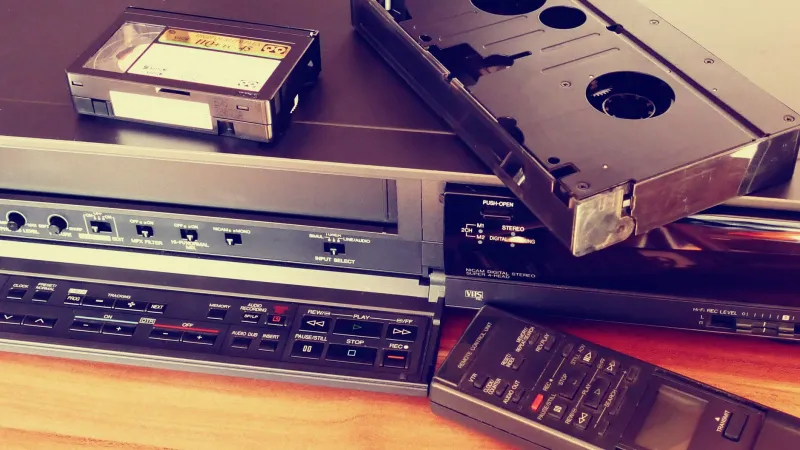
Somewhere in suburban Ohio in 1987, a kid named Derek hit rewind for the fourteenth time in a row. Same scene. Same five seconds. Same explosion of laughter from everyone on the couch. Nobody called it a meme. Nobody called it anything. They just kept hitting that button until the tape started to wear thin and the image got a little wobbly at the edges — which, honestly, made it funnier.
That ritual — obsessive, communal, completely analog — turns out to be one of the most important and underappreciated chapters in how Americans learned to consume, remix, and share culture. The pause-and-rewind loop wasn't a quirk of VHS ownership. It was the original meme engine.
The Button That Changed Everything
When VCRs started showing up in living rooms in the late 1970s and exploded through the 1980s, the obvious appeal was time-shifting — watching what you wanted, when you wanted. But something less obvious happened almost immediately. People started using the rewind function not to go back to the beginning of a movie, but to go back to one specific moment.
A pratfall. A background extra doing something bizarre. A line reading so perfectly weird it didn't feel real. An on-screen blooper that somehow made the final cut. Whatever it was, VHS gave viewers something no movie theater ever could: the ability to demand an encore from a recorded performance, on their own terms, in their own living room.
Collector and archivist Renata Fussel, who runs a small VHS library out of Portland, Oregon, remembers exactly which scene she rewound into near-oblivion as a teenager. "It was a moment in a comedy where an actor clearly forgot his line and just kind of stared into the camera for half a second before recovering," she says. "The director left it in. And we found it — my whole friend group — and we rewound it probably fifty times over one weekend. It became this inside thing. You'd just say a certain phrase from that scene and everyone knew."
That's the structure of a meme. Reference, recognition, community. The only thing missing was a way to share it beyond the room.
Inside Jokes at Scale
What made VHS rewind culture distinct from simply watching a movie twice was the granularity of it. You weren't re-watching a film. You were isolating a fragment and putting it on a loop — mentally if not literally. The brain started doing the same work that a GIF does today: stripping context, amplifying a single beat, letting that beat carry a disproportionate emotional or comedic payload.
Collectors who grew up in the VHS era describe this with a kind of reverence that's hard to fully explain to anyone who wasn't there. Marcus Tilley, a tape collector based in Atlanta who has been hunting VHS for over two decades, puts it plainly. "There were scenes that defined your whole friend group's sense of humor. You'd be at lunch at school and someone would just quote it — not even the full quote, just a piece of it — and you'd all lose it. And it came from rewinding. From obsessing over that one moment until it lived in your head permanently."
This was participatory media before the term existed. Viewers weren't passive recipients of whatever Hollywood sent down the pipeline. They were editors, curators, and comedic theorists — selecting what mattered, repeating it until it meant something, and transmitting it socially through shared reference.
The Tape Remembers What You Loved
Here's something that VHS collectors know and almost nobody else thinks about: a heavily rewound section of tape actually shows its history. The oxide wears differently. The image degrades in a specific pattern. You can sometimes see where someone loved a moment, because that stretch of tape looks different from everything around it.
"I've picked up tapes at estate sales where there's clearly one scene that got rewound hundreds of times," says Fussel. "The picture goes soft and wavy right at that spot. I always try to figure out what was so special about it. Sometimes it's obvious — a big action sequence or a famous scene. But sometimes it's something totally random, and that's the interesting part. Someone loved that moment enough to wear out the tape."
That physical record of obsession is something digital culture simply doesn't produce. A YouTube video doesn't degrade from being watched. A GIF doesn't wear out. The analog artifact carries the evidence of its own fandom in a way that feels almost poignant — a tape stretched thin by love.
From the Couch to the Culture
It's not a stretch to draw a direct line from VHS rewind culture to the participatory media habits that define how Americans consume content today. The instinct to isolate, repeat, share, and build community around a specific moment didn't start with Twitter or Reddit or Vine. It started on a couch, with a remote control, and a group of people who'd found something worth rewinding.
The formats changed. The scale changed — dramatically, globally, instantly. But the underlying behavior is the same. Find the moment. Repeat the moment. Make it mean something between you and the people you share it with.
Tilley sees it clearly from where he sits, surrounded by shelves of tapes in his Atlanta collection. "People act like meme culture is this new thing the internet invented. But we were doing it. We just couldn't share it with a thousand strangers — we could only share it with whoever was in the room. The room was smaller. The impulse was identical."
What Gets Lost When Nothing Wears Out
There's an argument — a genuinely uncomfortable one — that the friction of VHS rewind culture made it more meaningful. You had to work for your loop. You had to physically rewind, watch, rewind again. The tape had limits. Your patience had limits. The fact that you kept doing it anyway meant something.
Digital repeatability is infinite and effortless, which is probably why so much of it feels disposable. A meme lives for three days and vanishes. A VHS rewind moment could live in a friend group's collective memory for years — not because the tape was magic, but because the effort of obsessing over it together made it stick.
That's what VHS culture understood, even without knowing it was understanding anything. The rewind wasn't just a mechanical function. It was a vote. A declaration that this moment mattered enough to return to, again and again, until the tape itself started to show the strain.
Somewhere out there, there are still tapes with those worn-out patches. Somebody's favorite five seconds, encoded in degraded oxide, waiting for a collector to find them and wonder what the fuss was about.
We'd rewind to find out, if we could.