Press Rewind: The Quiet Revolution That Turned Couch Potatoes Into Film Curators
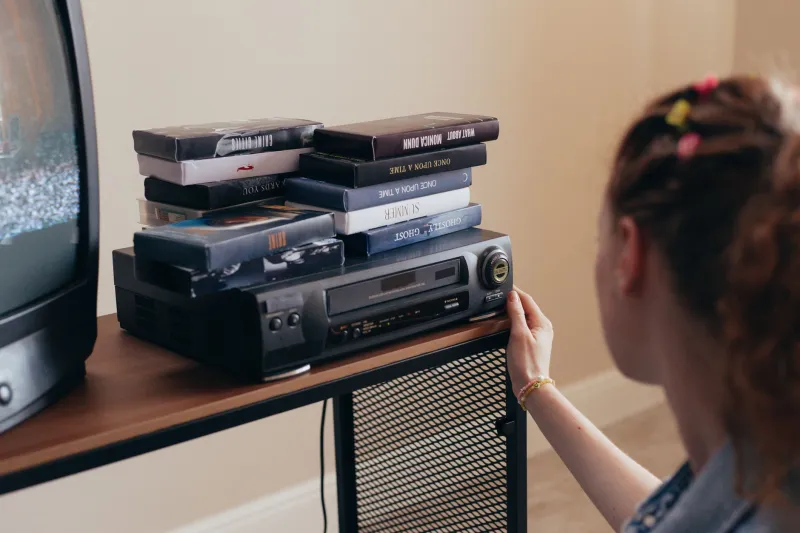
There's a sound that an entire generation carries somewhere in their bones. It's mechanical, a little clunky, and unmistakably satisfying — the high-pitched whir of a VHS tape rewinding inside a VCR. For millions of American families throughout the '80s and '90s, that sound wasn't just a technical necessity. It was a ritual. A signal that something worth watching was about to happen again.
We talk a lot about what VHS was — the format, the era, the aesthetic. But we don't talk nearly enough about what VHS did to the way we watch movies. And the rewind button, humble and mechanical as it was, might be the single most culturally underrated feature in the history of home entertainment.
From Passive Audiences to Active Viewers
Before the VCR went mainstream in the late 1970s and exploded through the '80s, watching a movie at home meant catching it on network television — commercials included, scheduled by someone else, often cropped and edited for content. You watched what was on. You watched when it aired. And when it was over, it was over.
The VCR changed the contract entirely.
Suddenly, you could rent a movie, own a movie, pause it when the phone rang, and — crucially — go back. You could rewatch the scene where Indiana Jones narrowly escapes the boulder. You could replay that moment in The Karate Kid when Daniel-san lands the crane kick. You could back up ten minutes because you missed a line of dialogue and, honestly, just wanted to hear it again.
"It sounds so simple now, but rewinding was genuinely radical," says Marcus Delray, a collector based in Atlanta who has amassed over 2,400 tapes since the early '90s. "Before VHS, film was this thing that happened to you. After VHS, you could participate in it. You decided what mattered enough to watch twice."
That act of rewinding wasn't passive. It was editorial. Every time someone hit that button, they were making a judgment call — this scene is worth seeing again. Over thousands of viewings across a lifetime, those judgment calls added up to something like a personal film education.
The Marathon Curators
One of the less-discussed byproducts of VHS culture was the rise of the home marathon — not just watching one movie, but building an entire evening (or a whole rainy Saturday) around a handpicked sequence of tapes. There were no algorithms, no autoplay queues. Just a shelf, a family vote, and whoever got to the VCR first.
Collector and film blogger Teresa Nguyen, who grew up in suburban Ohio, remembers her family's Friday night ritual vividly. "We'd line up three or four tapes on top of the TV before dinner. My dad would pick one, my brother would pick one, and I'd usually sneak in something I'd already seen five times because I knew every scene by heart. That was the point. You wanted to watch things you knew."
That intimacy — the deep familiarity that comes from repeated viewing — is something streaming culture has largely dismantled. When a catalog contains tens of thousands of titles and the interface constantly nudges you toward something new, there's little incentive to sit with a film long enough to really know it. VHS, by contrast, created a kind of forced depth. You owned maybe forty tapes. You watched them until the tracking got wobbly.
"My most-rewound tape is probably my worn-out copy of Ghostbusters," says Delray. "I watched it so many times as a kid that certain scenes are basically burned into my memory at a cellular level. I don't think I'd have that relationship with any movie if I'd grown up streaming."
The Mechanic That Made Memory
There's a neurological argument buried in here, though we're a pop culture site, not a science journal, so we'll keep it casual: repetition builds memory. The more times you watch something, the more deeply it encodes. VHS, almost accidentally, was a repetition machine.
Kids especially took to this. A child who loved The Lion King or Home Alone didn't just watch it — they studied it. They quoted it. They reenacted it. They rewound to their favorite parts so many times that their parents could practically recite the dialogue from the next room.
This kind of hyper-familiarity with specific films is something a lot of people in their 30s and 40s share as a generational touchstone. Ask someone who grew up in the '80s or '90s about their favorite childhood movie and they won't just tell you the title — they'll tell you the exact scene they rewound the most. That's the VHS experience in miniature.
"I can still tell you where the tracking would go fuzzy on my copy of Back to the Future," says Nguyen with a laugh. "Right around the clock tower scene. Every time. That flaw is part of the memory now."
What Streaming Got Wrong About Rewinding
Modern streaming platforms have a rewind function, technically. You can scrub back fifteen seconds with a tap. But it's not the same thing, and most people who grew up with VHS will tell you that without being able to fully articulate why.
Part of it is friction. Rewinding a VHS tape took time. You had to commit. You hit the button, the machine whirred, and you waited. That waiting created anticipation. It signaled to everyone in the room that what was coming was worth the wait. There was social weight to it.
Streaming's instant scrubbing, by contrast, is frictionless to the point of meaninglessness. You can go back anywhere, anytime, effortlessly — which somehow makes it feel like you're going back nowhere in particular.
There's also the ownership piece. When you rewind a tape you own, you're returning to something that belongs to you. Your fingerprints are on the case. Your memories are layered into every viewing. Rewinding a stream feels more like refreshing a webpage.
The Tapes That Defined Us
Ask any serious VHS collector about their most-rewound tapes and you'll get answers that feel less like film recommendations and more like autobiography. Raiders of the Lost Ark. Beetlejuice. Die Hard. Dirty Dancing. The Princess Bride. These aren't just great movies — they're films that a specific generation wore down to the nub through sheer repetition, building emotional architecture that holds up decades later.
"The tapes I've rewound the most are the ones that feel like home," says Delray. "Not necessarily the 'best' films by any critical standard. Just the ones I needed to go back to."
That's the real legacy of the rewind button. Not a technical feature, but a cultural one. It taught a generation that movies weren't just events to be consumed and discarded — they were places you could return to. Sanctuaries, almost. Familiar rooms you could walk back into whenever the world got loud.
Streaming gave us more. VHS gave us depth. And sometimes, depth is the thing you miss most when it's gone.
Got a tape you've rewound more times than you can count? Tell us about it in the comments — we want to hear what scenes your VCR practically memorized for you.