Hunting the Unwanted: The Beautiful Obsession of Collecting Films Nobody Streamed
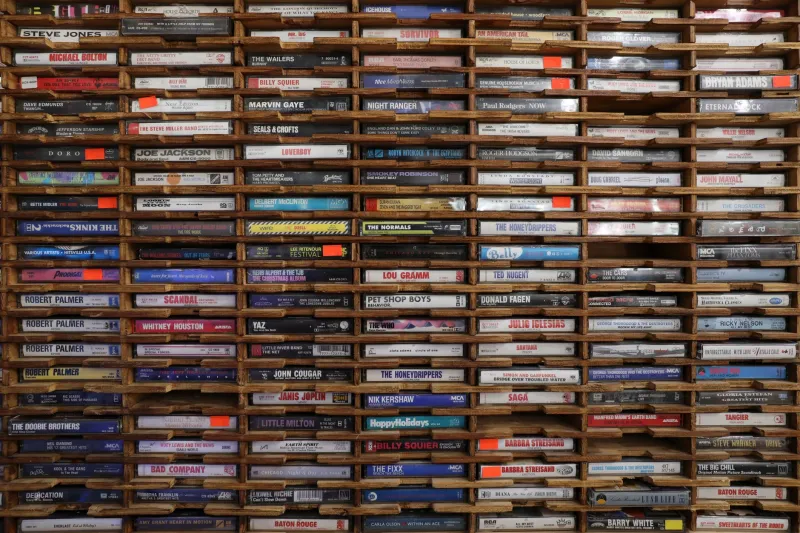
Walk into any serious VHS collector's space and you'll notice something immediately. The tapes lining the shelves aren't the ones you'd expect. Sure, there might be a worn copy of Ghostbusters or a faded Top Gun clamshell tucked in somewhere. But the real estate — the prime shelf space, the carefully arranged rows — belongs to something else entirely. Ninja Terminator. Sorority Babes in the Slimeball Bowl-O-Rama. The third entry in a slasher franchise that barely warranted a second. These aren't accidents. They're trophies.
The psychology behind this kind of collecting is more interesting than it looks from the outside, and it says a lot about what happens when you take discovery out of human hands and give it to a machine.
The Algorithm Has No Interest in Your Curiosity
Here's the thing about streaming recommendations: they're designed to keep you watching, not to expand what you know. The entire system is engineered around engagement metrics, which means it surfaces content that resembles what you've already seen. If you watched one legal thriller, you'll get twelve more. The genuinely strange, the commercially marginal, the films that existed only on tape and never made the digital transition — those don't exist in that world. They can't be recommended because they were never uploaded. They can't be discovered because discovery isn't really the point.
VHS collectors understand this, even if they don't always articulate it that way. When you're digging through a bin at a weekend flea market in Ohio, sorting through warped cases and sun-faded labels, you're operating in a completely different discovery ecosystem. One where nobody curated the selection for you. One where the next tape you pull out could be something you've genuinely never heard of, made by people you'll have to research, in a genre you didn't know existed.
That feeling — genuine, unmediated surprise — is increasingly rare. Collectors are chasing it on purpose.
The Direct-to-Video Universe Was Its Own Civilization
Between roughly 1983 and the late 1990s, the direct-to-video market wasn't a dumping ground for failed theatrical releases. It was a functioning parallel film industry with its own stars, its own studios, its own aesthetic sensibilities, and its own audience. Companies like Vestron Video, Media Home Entertainment, and Prism Entertainment cranked out hundreds of titles annually — action films, horror anthologies, low-budget science fiction, regional comedies — that never played a single movie theater but found their way into rental stores across the country.
These films were made fast, cheap, and with a specific kind of creative freedom that bigger productions couldn't afford. When you had a $400,000 budget and two weeks to shoot, you made choices. Sometimes those choices were terrible. Sometimes they produced something genuinely weird and alive in ways that a $40 million studio picture never could be.
Collectors who specialize in this era aren't just hoarding junk. They're preserving evidence of an entire creative ecosystem that the mainstream film industry has largely written out of its own history.
The Hunt Is the Point
Ask a serious obscure-VHS collector why they do it, and most of them will eventually get around to the same answer: the hunt matters as much as the find. Maybe more.
There's a ritual to it. You show up to the thrift store before it opens on a Saturday morning. You work through the tape rack systematically, reading every spine. You develop an eye for labels you've never seen before, for hand-drawn cover art, for the particular font choices that signal a regional distributor operating out of somewhere like Van Nuys or Nashville. You pull a tape, flip it over, read the back copy — and the back copy on a direct-to-video release from 1987 is its own art form, written by someone who was clearly trying very hard to make a low-budget werewolf film sound like the most urgent cinematic event of the decade.
When you find something genuinely unknown — a title that doesn't appear in any database, a film with no Wikipedia page, a cast of actors who seem to have existed only for this one project — the feeling is legitimately electric. You are holding something that the rest of the world forgot. That's not nothing. That's actually quite a lot.
Preservation as Pushback
There's also something quietly political about this kind of collecting, even if most collectors wouldn't frame it that way.
The streaming era has created a new kind of film canon — not based on critical consensus or historical importance, but based on what the major platforms chose to license and digitize. Films that didn't fit that calculus, films whose rights are tangled or whose original studios no longer exist, films that were simply deemed too obscure to bother with — those are disappearing. Not dramatically, not all at once, but steadily, as the tapes that hold them deteriorate and nobody makes new copies.
VHS collectors who seek out these films are, whether they think of it this way or not, acting as an informal preservation network. Every tape that gets rescued from a donation bin, cleaned up, and stored properly is a film that survives a little longer. Every collector who catalogs their holdings and shares that information online is contributing to a record that didn't exist before.
The irony is that the films they're saving are often the ones that the industry valued least when they were made. The B-movies, the sequels, the regional oddities. The stuff nobody thought was worth keeping.
What 'Bad' Actually Means
One more thing worth saying: the collectors who pursue this material aren't all doing it ironically. The assumption from the outside is often that people who collect direct-to-video horror or straight-to-tape action films are in on some kind of joke, enjoying the badness as a form of cultural superiority.
Some of that exists, sure. But talk to enough serious collectors and you'll find something more genuine underneath. A real appreciation for craft under constraint. An understanding that a film made for almost no money by people who cared deeply about what they were making has its own kind of integrity. An affection for the specific texture of that era — the synth scores, the practical effects, the character actors who showed up in forty of these things and were always worth watching.
'Bad' is a word that mostly means 'not what the mainstream expected.' VHS collectors decided a long time ago that mainstream expectations are a pretty limited lens for looking at film history. They went hunting for everything that fell outside it. They're still out there, every weekend, working through the bins.
And occasionally, they find something that genuinely deserved to be found.