Be Kind, Rewind, and Fall in Love: The Surprisingly Intimate Romance of the VHS Era
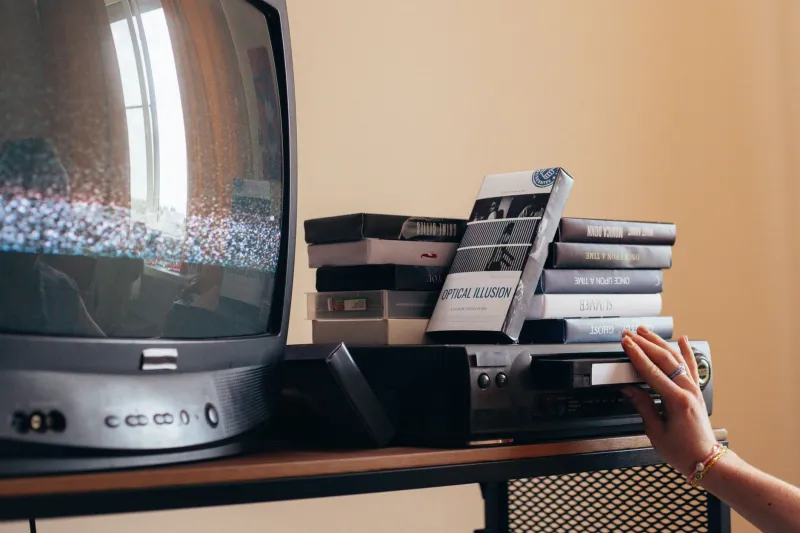
There's a moment a lot of people remember even if they can't quite name it. You're standing in front of your VCR, finger hovering over the record button, trying to time the pause just right so the tape doesn't catch the commercial break before your favorite song kicks in. You're not making this for yourself. You're making it for someone else. And that distinction — that shift in audience — changed everything.
VHS wasn't just a format. For a solid decade and a half, it was the medium through which a generation conducted some of its most tender, most anxious, most carefully considered romantic gestures. The mixtape gets all the cultural credit these days, but the blank VHS tape was doing the same emotional heavy lifting in living rooms across America, and it rarely gets its due.
The Blank Tape as Love Letter
Anybody who came of age between roughly 1983 and 1999 knows the ritual. You'd buy a three-pack of blank T-120s from the drugstore — Maxell, TDK, BASF if you were feeling fancy — and you'd sit down with a purpose. Maybe you were recording a movie off cable that your girlfriend mentioned she'd never seen. Maybe you were compiling every music video that reminded you of someone into a single ninety-minute time capsule. Either way, the act demanded patience, presence, and a kind of sustained attention that feels almost foreign now.
You had to be there for it. You couldn't queue it up and walk away. You had to watch the clock, manage the tape counter, write out the label by hand. The physical object that emerged from all that effort carried the weight of the time you'd spent on it. When you handed it over, the other person knew — they felt — that this had cost you something. Not money. Something more valuable than that.
Digital sharing doesn't work that way. Sending someone a Spotify playlist takes about forty-five seconds. It's a lovely gesture, but it doesn't bleed. A handwritten label on a VHS cassette did.
The Anxiety of the Borrowed Tape
Of course, VHS romance wasn't all tender curation and warm feelings. It had its own specific brand of low-grade dread, and anyone who lived through it will tell you about it with a wince and a laugh.
The borrowed tape was its own complicated social contract. You lent someone your copy of Dirty Dancing or Say Anything — your personal, recorded-off-HBO copy with the slight tracking wobble at the beginning — and in doing so you handed them something irreplaceable. Tapes accumulated meaning through use. The worn label, the way it clicked into the VCR just so, the little handwritten note on the spine — these weren't just physical quirks, they were history. Your history.
And then there was the nightmare scenario: coming home to discover that your roommate, your sibling, or — God forbid — your partner had recorded over it. Not out of malice, just carelessness. Just a blank-looking tape sitting on top of the VCR, fair game as far as they knew. The fallout from that particular accident could last days. It sounds absurd now, but the grief was real. You weren't just losing a movie. You were losing the specific Saturday afternoon you'd spent recording it, the version of yourself who'd written that label.
Friday Night as a First Date
The video store deserves its own chapter in the story of American courtship, and it's one that's been told in bits and pieces but never quite fully appreciated. Walking the aisles of a Blockbuster or an independent rental shop with someone you were newly interested in was a remarkably revealing experience. The movies people gravitated toward, the ones they talked about with that particular light in their eyes, the ones they'd already seen four times — all of it was data. Rich, unguarded, genuine data about who they were.
There was negotiation involved, too, which is its own kind of intimacy. You'd hold up RoboCop, they'd counter with When Harry Met Sally, and somewhere in that back-and-forth you'd start to figure out whether your sensibilities were actually compatible. It was low-stakes and high-information at the same time. The video store was, in a very real sense, a compatibility test disguised as a Friday night.
And then you'd take the tape home, and the watching of it was its own event. You sat together on a couch, in front of one screen, with no second screens to retreat to. If the movie was boring, you talked. If it was scary, someone grabbed someone else's arm. The shared experience was non-negotiable, which meant that what happened on that couch — the conversation, the laughter, the comfortable silence — mattered in a way that's genuinely hard to manufacture in the age of individual viewing queues.
Gifting the Permanent Copy
Somewhere above the borrowed tape and below the engagement ring, there existed a mid-tier romantic gesture unique to the VHS era: buying someone their own copy of a movie they loved.
This sounds simple, but the economics of it made it meaningful. Pre-recorded VHS tapes were expensive. Through most of the '80s, a new release could run you $80 to $100 at retail. Even as prices dropped in the early '90s, a purchased tape still represented a real decision. You'd thought about this person enough to go to the store, pick the right title, maybe even track down a hard-to-find one. You were saying: I want you to have this permanently. I want it to live on your shelf.
There's something almost poignant about that impulse now that everything is technically permanent but nothing feels owned. A digital purchase lives in a cloud account somewhere, revocable by licensing agreements and corporate decisions. A VHS tape on someone's shelf was theirs. Unambiguously, physically, undeniably theirs. That kind of permanence meant something.
What We Lost in the Shuffle
None of this is to say that modern romance is impoverished — people find extraordinary ways to connect across every era and every technology. But there's something worth sitting with in the specificity of what VHS required: time, attention, physical presence, irreversible commitment. You couldn't unsend a tape. You couldn't quietly unlike it from someone's feed. Once you handed it over, it existed in the world as a record of what you'd felt.
That's a vulnerability that most of us today have learned to protect ourselves from, and maybe that's fine. But every now and then, when you're digging through a box of old tapes and you find one with a handwritten label that says something like For You — the good stuff in faded ballpoint pen, you get a flash of what it felt like to mean something that concretely.
Rewind to that. It's worth the trip.