The Machine Is the Message: Why Working VCRs Are Now the Holy Grail of Home Video Collecting
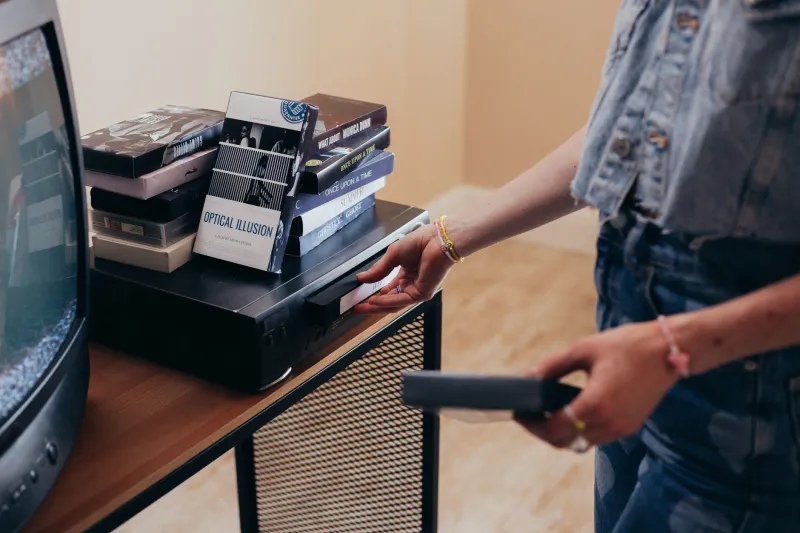
Walk into any Goodwill in America on a Saturday morning and you'll find tapes. Stacks of them. Clamshell cases of Die Hard, water-warped copies of Dirty Dancing, grocery bags full of home recordings with masking-tape labels in handwriting nobody can identify anymore. The supply of VHS tapes, at least for now, remains almost comically abundant.
The machines to play them on? That's where things get complicated.
Somewhere in the last decade, the economics of VHS collecting quietly flipped. The software got cheap and plentiful. The hardware became scarce, fragile, and increasingly irreplaceable. A decent working VCR that would've been left on the curb in 2008 can now command anywhere from $50 to several hundred dollars depending on the brand, condition, and whether it's been recently serviced. High-end decks from manufacturers like JVC, Panasonic, and Sony—machines that were considered premium even in their prime—routinely clear $300 to $500 on eBay, sometimes more. And demand isn't cooling off.
When the Tool Becomes the Treasure
For most of the format's lifespan, the VCR was purely functional. It was furniture, essentially—something that sat under the TV and did its job without anyone thinking much about it. When DVD players arrived and streaming eventually swallowed everything, VCRs got donated, trashed, or shoved into closets. Millions of units were manufactured, and millions were discarded.
But manufacturing stopped. Funai Electric, the last company producing new VCRs, shut down that line in 2016. No new machines have entered the market since. Every working unit in existence today is a finite resource slowly being drawn down by age, mechanical failure, and the simple passage of time.
Collectors who've been in the VHS game long enough saw this coming. "I started grabbing extra machines maybe six or seven years ago," says Marcus, a collector based outside of Nashville who runs a small tape trading operation and asked that his last name not be used. "Not because I was trying to flip them—I just knew that eventually the math wouldn't work anymore. You can have a thousand tapes and they're useless without something to run them through."
That math is now very much not working for casual enthusiasts who waited too long.
The Anatomy of Scarcity
Understanding why VCRs fail helps explain why good ones are so hard to find. The machines are mechanical in ways that most modern electronics simply aren't. Rubber belts and pinch rollers dry out and crack. Capstan assemblies wear down. The foam that cushions the tape path degrades into a sticky residue that can destroy both the machine and any tape loaded into it. A VCR that looks fine and powers on can still be a tape-eating disaster waiting to happen.
This is why collectors have learned to be suspicious of untested units. A VCR sitting in a garage for fifteen years might power on, display a blue screen, and appear perfectly functional right up until it chews through something irreplaceable. The phrase "sold as-is" in a listing description has become a minor red flag in collector circles.
The machines that command real money are the ones that have been cleaned, inspected, and ideally serviced by someone who knows what they're doing. Which brings us to the underground.
The Repair Networks Nobody Talks About
There's a loose, informal ecosystem of technicians and hobbyists across the country keeping VCRs alive. Some are retired electronics repair professionals who never stopped caring about the format. Others are younger enthusiasts who taught themselves through YouTube tutorials and trial and error. They operate out of basements and spare bedrooms, sourcing replacement belts and rollers from specialty suppliers, rebuilding machines that most people would consider beyond saving.
Online communities—Reddit forums, Facebook groups, Discord servers—have become the connective tissue of this repair world. Someone in Ohio posts about a belt replacement on a specific JVC model, and three people in different states reply with the exact part number and where to order it. Knowledge that would've died with the last repair shop is being collectively preserved in comment threads and pinned posts.
"The community is genuinely what's keeping this format functional," says Denise, a hobbyist technician in the Pacific Northwest who services machines for other collectors, mostly by word of mouth. "There's no business model here. People do it because they care. But it also means the whole thing is fragile in ways that are hard to explain to someone who isn't already inside it."
The parts situation, she notes, is the long-term concern. Replacement belts and rollers are still available—for now. Certain components are already becoming difficult to source. As machines age further, the list of unavailable parts will only grow.
What Collectors Are Actually Hunting For
Not all VCRs are created equal in the collector market, and enthusiasts have developed fairly specific preferences. Hi-Fi stereo decks are considered essential by anyone serious about audio quality. S-VHS machines, capable of higher resolution playback, are prized even by collectors who don't own S-VHS tapes, simply because they tend to be better-built overall. Certain JVC and Mitsubishi models from the late '80s and early '90s have developed almost cult-like followings based on their mechanical reliability and picture quality.
Brand loyalty runs deep. Ask a serious collector which manufacturer they trust and you'll get a passionate, specific answer. The debate between JVC and Panasonic partisans has been running in online forums for years without any sign of resolution.
Estate sales and thrift stores remain the primary hunting grounds for deals, though word has gotten out enough that the window for finding a genuinely underpriced machine is narrower than it used to be. Thrift store employees in larger cities have started pricing VCRs more aggressively. The arbitrage that defined early VHS collecting—buy cheap, know what you have—is harder to pull off than it was even five years ago.
The Last Player Problem
Here's the question that nobody in the VHS community loves sitting with: what happens when the machines are gone?
Digitization is the practical answer, and it's a real one. Capturing tape content to digital files before the hardware fails is the preservation path most archivists and serious collectors already walk. Organizations like the Internet Archive have been working on this for years. Individual collectors are doing it in living rooms with varying degrees of success and equipment quality.
But digitization doesn't preserve the experience of VHS in any meaningful way. The format—the warmth, the grain, the slight tracking instability that gives old tapes their texture—exists in the physical interaction between tape and machine. You can capture an approximation of what a tape looks like. You can't really bottle what it feels like to watch one.
For collectors, that distinction matters enormously. The VCR isn't just a delivery mechanism. It's the other half of the format. Without it, VHS is just a box on a shelf.
Marcus puts it simply: "People ask me why I keep buying machines. It's because the tape is just a recording. The player is what makes it real."
He's got eleven working units at last count, stored carefully, serviced regularly. He's already thinking about twelve.