The Friction Was the Feature: What VHS Taught Us About Paying Attention
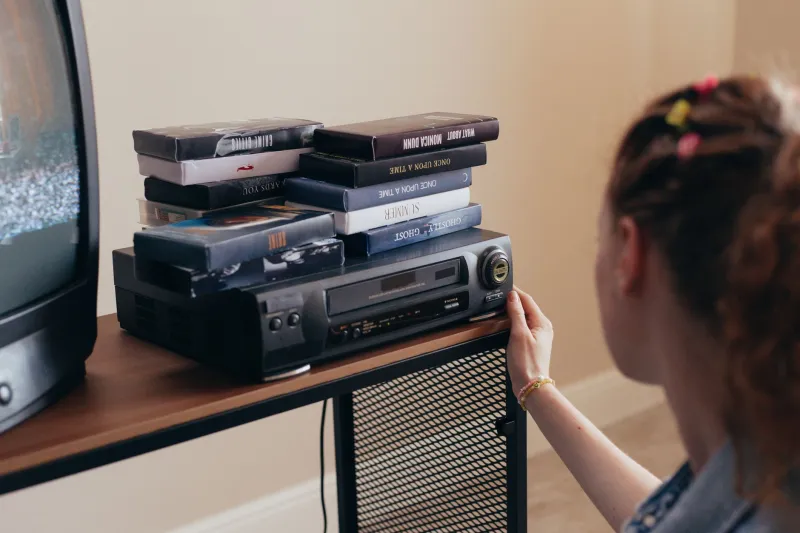
There's a moment most of us remember, even if we've never put words to it. You've just finished a movie on VHS. The credits roll. The tape hisses into static. And instead of something else immediately filling the screen, there's just... a pause. You have to decide what comes next. You have to get up.
That pause mattered more than we realized at the time.
We live in an era of content designed to eliminate exactly that kind of pause. Autoplay queues up the next episode before the outro music even finishes. Recommendation engines are built to keep your eyes on the screen as long as physically possible. The whole architecture of modern streaming is engineered around the removal of friction—every small obstacle between you and the next piece of content has been sanded down, buffed out, optimized away.
But here's the thing: that friction wasn't a bug. It was doing something important.
The Rewind as a Ritual
Rewinding a tape was annoying. Nobody's going to argue otherwise. You finished the movie, you ejected the cassette, and now you had to either sit through the mechanical grind of rewinding right then or—if you were the kind of person who ignored the "Be Kind, Rewind" stickers at the rental place—leave it for whoever came next. It took time. It required action.
But that action created a boundary. A film ended, and the physical process of rewinding it drew a clear line between that viewing experience and whatever came after. Your brain got a moment to process what it had just watched. The story had room to settle.
Psychologists who study memory consolidation talk about the importance of "offline" time after learning—those quiet moments when the brain isn't absorbing new input and instead works to encode what it just experienced. VHS, completely by accident, built that offline time right into the viewing ritual. You rewound the tape. Maybe you talked about the movie with whoever you watched it with. Maybe you just sat there for a second. Either way, your brain got a chance to do its thing.
Streaming gives you none of that. The next episode loads. Your brain pivots. Whatever you just watched gets buried under whatever's coming.
Commitment Changes How You Watch
There's another piece of this that doesn't get enough attention: the commitment required to watch something on VHS changed the quality of attention you brought to it.
Think about how you chose a tape for the night. If you were renting, you drove to the video store—sometimes more than once if your first choice was already checked out. You stood in the aisle. You read the back of the box. You made a decision. By the time you got home and hit play, you were invested. You'd done work to get there.
Even if you were just pulling something from your own shelf, the act of choosing, loading, and committing to a tape created a kind of contract with yourself. You were watching this movie tonight. Not half of this movie and then something else. Not this movie with your phone in your hand the whole time. This movie.
That commitment shaped behavior. People watched VHS films more attentively, more completely. And because you couldn't seamlessly jump between options, you stayed with something even when it got slow, even when it asked something of you. Sometimes that patience paid off in a scene or a third act that would have been missed if you'd bailed at the first sign of difficulty.
The Inability to Skip Was a Gift
Linear playback sounds like a limitation until you think about what it actually meant in practice. You couldn't skip ahead on VHS without fast-forwarding—and fast-forwarding was imprecise, annoying, and often meant overshooting the scene you wanted. So mostly, you didn't skip. You watched the movie as it was constructed to be watched.
This matters because films—especially good ones—are built around pacing, around the rhythm of information being revealed at a specific rate. Backstory that feels slow in minute twenty is doing work that pays off in minute eighty. Character moments that seem unnecessary become the emotional foundation for everything that follows. When you skip, you're not just jumping past content; you're dismantling the architecture the filmmaker spent years building.
VHS made it easier to just... let the movie happen. And in doing so, it produced viewers who understood stories differently, who sat with discomfort, who let meaning accumulate rather than demanding it immediately.
Revisiting vs. Rewatching
Here's a distinction worth drawing: there's a difference between rewatching something and revisiting it.
Rewatching is passive. You've seen it before, it's comfortable, it's on in the background while you do other things. Streaming enables endless rewatching—familiar shows playing on loop as ambient noise, half-absorbed while you scroll through your phone.
Revisiting is intentional. You go back to something because you want to experience it again, fully, because it meant something to you. VHS collectors know this feeling better than anyone. You pull a tape off the shelf because you need to see that movie again. You rewind it. You sit down. You watch it.
The physical object—the cassette itself, the cover art, the weight of it in your hands—is part of what triggers that intentionality. It's harder to be passive about something you had to physically choose and load. The object asks something of you before the movie even starts.
What We Lost When We Gained Everything
Nobody's arguing that streaming isn't convenient. It's incredibly convenient. The ability to watch almost any movie ever made, any time, from your couch, is genuinely remarkable. The problem isn't the access. The problem is what unlimited frictionless access does to our relationship with the content itself.
When everything is available instantly and endlessly, nothing feels particularly precious. The experience of watching becomes disposable—something to consume and move past rather than something to sit with. Studies on choice overload suggest that more options frequently lead to less satisfaction, not more, because the abundance itself undermines the meaning of any individual choice.
VHS collectors aren't just nostalgic for a format. They're nostalgic for a relationship with media that felt more deliberate, more personal, more real. The tape you owned was yours. The movie you rented was the movie you chose tonight. The experience of watching it was bounded and specific and memorable in a way that the fourteenth thing you half-watched last Tuesday absolutely is not.
Bringing the Friction Back
You don't have to dig a VCR out of storage to apply some of this. The lesson VHS offers isn't really about the technology—it's about intentionality. Choosing what you watch before you sit down. Finishing things before starting something else. Putting your phone in another room. Giving yourself a beat after a movie ends before the next thing starts.
But if you do want to dig that VCR out of storage? We'd fully support it. There's something that happens when you drop a tape in, hit play, and let the tracking lines settle that no streaming interface has ever replicated. A kind of readiness. A settling in.
The friction was always the feature. We just didn't know to appreciate it until it was gone.