Before You Press Play: What We Lost When Previews Stopped Being an Event
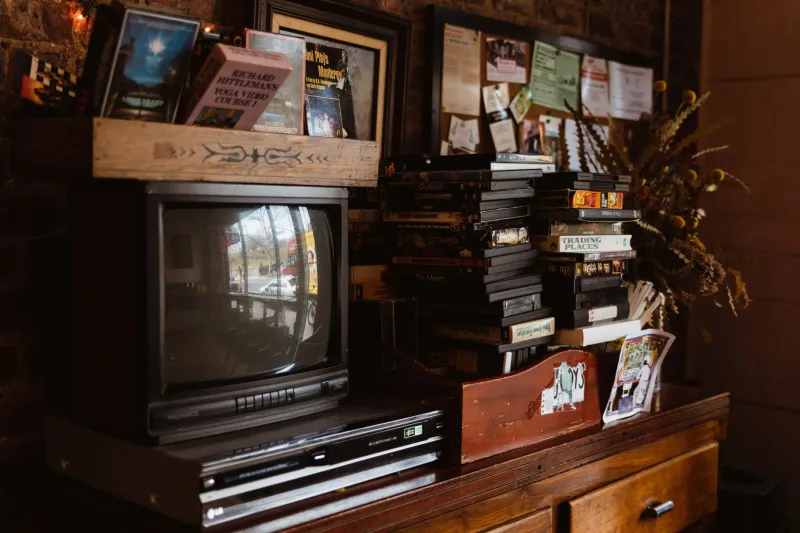
Let's talk about the FBI warning.
You know the one. Black screen, white text, the federal anti-piracy notice that opened virtually every commercially released VHS tape. Nobody read it carefully. Nobody needed to. But it was there, every time, a brief institutional moment before the entertainment began. After it came the Interpol warning, then usually a studio logo — the Paramount mountain, the Universal globe slowly rotating, the Columbia woman with her torch. Then, finally, the previews.
You couldn't skip any of it. The fast-forward button existed, technically, but the anti-piracy section was often encoded to defeat it, and on rental tapes you were at the mercy of however the previous renter had left the tape. You sat through it. And in sitting through it, something happened that we've largely stopped understanding how to value: you were made to wait. You were made to anticipate. You were given a brief, involuntary education in what else was out there before you got to what you came for.
The Trailer as Appointment Television
VHS trailers occupied a peculiar cultural space. They weren't the same as theatrical trailers, which you encountered by chance based on whatever movie you'd paid to see that Friday night. Home video previews were curated specifically for the tape they preceded, which meant they were usually targeted at the same audience. A horror film came loaded with horror previews. A kids' movie opened with coming attractions aimed at kids.
This wasn't accidental. Studios and distributors understood that the person who rented Nightmare on Elm Street Part 4 was exactly the person who might want to know about the new Clive Barker adaptation. The trailer placement was marketing, obviously. But it was also discovery — genuine, relevant discovery aimed at a specific viewer who had already self-selected into a genre.
For a lot of VHS-era viewers, especially in the 1980s and early '90s when entertainment journalism was limited to whatever your local newspaper covered and maybe a subscription to Entertainment Weekly, these trailers were a primary source of information about what was coming. You learned about movies from the movies themselves. The tape was its own ecosystem.
The Studio Logo as Emotional Preparation
Something worth recovering from nostalgia and examining seriously: the function of the studio logo sequence.
These were rarely more than thirty seconds. A fanfare, a visual, a brand identifier. But they did something specific to a viewer's brain. They signaled a register. A Universal logo meant something different from a New World Pictures logo, which meant something different from the Cannon Films logo. Regular VHS watchers learned to read these identifiers the way you'd learn to read a record label — they told you something about the production values, the genre sensibilities, the general level of ambition you were about to encounter.
The Cannon Films logo, for instance — that specific font, that particular fanfare — became associated with a very specific kind of mid-'80s action film. Chuck Norris, Charles Bronson, ninjas, explosions, a certain cheerful disregard for narrative plausibility. When that logo appeared, you knew what you were getting. That knowledge was part of the experience. It calibrated your expectations in a way that made the film itself more enjoyable because you'd arrived at it correctly prepared.
Streaming services have logos too, of course. But they're brand identifiers for distribution platforms, not production companies. They tell you who's delivering the content, not who made it or what sensibility shaped it. The meaning has been hollowed out.
Rewinding to the Previews on Purpose
Here's a behavior that probably sounds insane to anyone who didn't grow up with VHS: people rewound to watch the previews again.
Not all people, not all the time. But it happened. You'd finish a movie, rewind the tape, and instead of popping it out, you'd let it play from the beginning specifically to watch the trailers again. Sometimes because a particular preview had caught your attention and you wanted to write down the title. Sometimes because a younger sibling wanted to see the one for the movie with the dinosaurs again. Sometimes just because the previews were good and you had nothing else to do.
This is a behavior that makes no sense in a streaming context, where the preview for a film is always one click away and the film itself is available immediately. But it made complete sense in a world where a trailer represented your only access to a film you couldn't yet see. The preview was a substitute for the experience itself. It was something you could return to while you waited.
That waiting — the gap between wanting to see something and being able to see it — was where anticipation lived. Anticipation is not a neutral state. It's generative. You think about the film. You imagine it. You talk about it with people who also saw the trailer. By the time you actually watch the thing, you've already invested something in it.
The Collapse of the Gap
Streaming didn't just change how we access content. It eliminated the gap entirely.
Today, the journey from 'I want to watch something' to 'I am watching something' takes approximately fifteen seconds. You open an app, you scroll a grid, you click. The film begins. There is no FBI warning, no studio logo sequence, no trailers for films you haven't decided to watch yet. There is only the immediate gratification of the thing you already chose.
This is, by most objective measures, more convenient. It is also, by most experiential measures, significantly less interesting.
The VHS trailer sequence forced a kind of passive discovery that felt like a small adventure every time. You didn't know exactly what previews would be on this tape. You might encounter something you'd never heard of. You might see an actor you recognized from something else appearing in a completely different context. The previews were a window into the wider landscape of what cinema was doing at that particular moment, and you got that window whether you wanted it or not.
What the Tape Knew That the Algorithm Doesn't
The curators who assembled those preview reels — and there were actual human beings making those decisions, selecting which trailers preceded which films — understood something about how audiences discover content. They understood that adjacency matters. That what you encounter before the thing you came for shapes how you feel about the whole experience. That a little bit of friction, a little bit of 'here's something you didn't ask for,' is actually a form of generosity.
Algorithms don't do this. They show you what you've already demonstrated you like. They optimize for immediate satisfaction and minimal friction. They are extraordinarily good at giving you exactly what you want and extraordinarily bad at giving you anything you didn't know you wanted.
The VHS preview reel was imperfect, commercial, and often completely irrelevant to your actual taste. It was also, quietly, one of the best discovery mechanisms that home entertainment ever produced. You can't rewind to it. But it's worth remembering what it gave us.