The Oxide Clock: Why Your Family's Home Videos Are on Borrowed Time
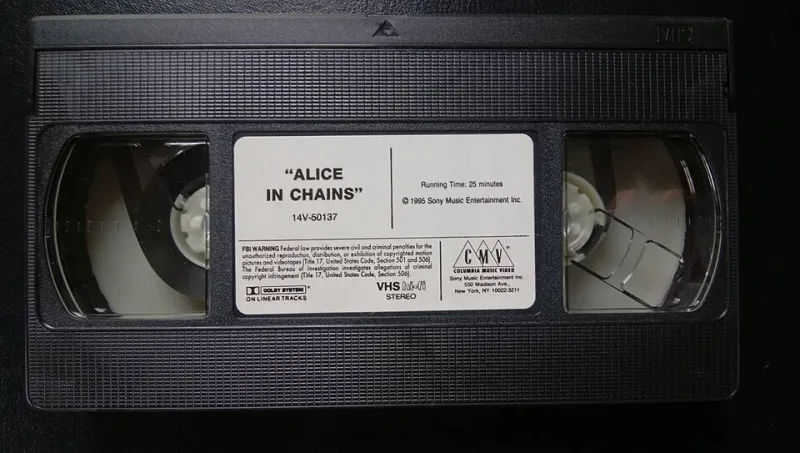
Photo: English: Label printed by Columbia Music Video, the distributor of the VHS., Public domain, via Wikimedia Commons
There's a shoebox in your parents' closet right now — maybe two — full of tapes labeled in ballpoint pen. Christmas '86. Sara's recital. Grandma & Grandpa — DO NOT TAPE OVER. And every single one of them is running out of time.
Not metaphorically. Literally. Magnetic tape has a shelf life, and for most VHS cassettes recorded between 1980 and 1999, that clock started ticking decades ago. The archivists who do this for a living have a name for what's coming: sticky shed syndrome, oxide shedding, signal dropouts. Families have a different name for it, usually shouted the first time they try to play a tape and all they get is snow and a ghostly audio warble.
What's Actually Happening Inside the Cassette
A VHS tape is essentially rust glued to plastic. More precisely, it's magnetic oxide particles bonded to a polyester backing, and that bond was never meant to last forever. Heat, humidity, and simple gravity work on it constantly. The oxide layer absorbs moisture, the binder softens, and when you finally hit play, the particles smear across the spinning heads instead of passing over them cleanly.
The symptoms are easy to recognize once you know them. Tracking lines that no amount of dial-twisting will fix. Audio that sounds like it's underwater. White speckles that look like static snow even on a clean tape. In the worst cases, the tape actually leaves brown residue on the VCR's heads — the machine equivalent of coughing up blood.
Temperature swings make it worse. That closet in an un-air-conditioned attic in Georgia? That tape has maybe five good years left. Even a climate-controlled basement in Minnesota only buys you so long. Archivists generally agree that magnetic media has a practical window of 10 to 30 years depending on storage conditions, and most home recordings are already deep into that window.
The DIY Transfer Scene Is Bigger Than You Think
Here's the good news: you don't need a professional archive to save these tapes. You need a working VCR, a way to connect it to a computer, and a free afternoon.
The classic setup is a VCR hooked to a USB capture device — the kind that sells for $15 to $40 at any electronics retailer — plus free software like OBS Studio or the software bundled with the capture stick. You hit play on the tape, hit record on the computer, and wait in real time. A two-hour tape takes two hours. There's no shortcut, and honestly, that's part of the charm. You end up watching your uncle's graduation footage for the first time in thirty years while the machine does its work.
The hobbyists who do this at scale have strong opinions about gear. A decent deck matters more than an expensive capture card — a worn-out VCR with dirty heads will degrade the transfer no matter what's downstream of it. Some enthusiasts keep a "workhorse" deck they clean and calibrate regularly, and a few track down time-base correctors, pieces of broadcast equipment that stabilize the wobbling signal from old tapes.
And if DIY sounds like a nightmare? Professional transfer services exist in nearly every mid-sized American city, typically charging $10 to $25 per tape. For genuinely precious footage — the only copy of a wedding, say — that's money well spent.
The Tapes Worth the Most Effort
Not every tape in the box deserves the same urgency. Archivists suggest triaging:
- One-of-a-kind recordings come first. Home movies, family events, anything with no duplicate. A taped-off-TV movie can theoretically be found again; your grandfather's retirement party cannot.
- Tapes showing physical damage — mold spots visible through the window, a sour smell, visible wrinkles on the edge of the tape — need attention before they contaminate your working VCR. Mold spreads between tapes stored in the same box.
- The labels matter too. Photograph the handwriting before you transfer. That scrawled "Easter — Mom's house" in your late grandmother's hand is its own kind of artifact.
One more tip the pros swear by: don't store tapes flat in a stack. Standing them upright like books, in a cool dry room, relieves stress on the cassette shell and the tape edges.
"Someday" Is Not a Preservation Plan
The most common sentence in home video preservation is some version of "we should really get those digitized someday." It gets said at holidays, at funerals, while cleaning out a house. Then the box goes back in the closet and the clock keeps running.
The uncomfortable math is simple. The generation that recorded these tapes is aging, and the generation that remembers what's on them is aging right alongside. A tape without context — an unlabeled cassette of a backyard barbecue with no surviving witnesses — becomes a mystery in a plastic shell. Every year of delay increases the odds that the footage survives but the meaning doesn't.
So consider this your nudge. Dig out the box, plug in the deck, and press play. Worst case, you spend a Saturday afternoon watching your family's history flicker by. Best case, you save it — before the rust has the last word.