One More Time: How Rewinding a Single Scene Changed the Way We Remember Movies
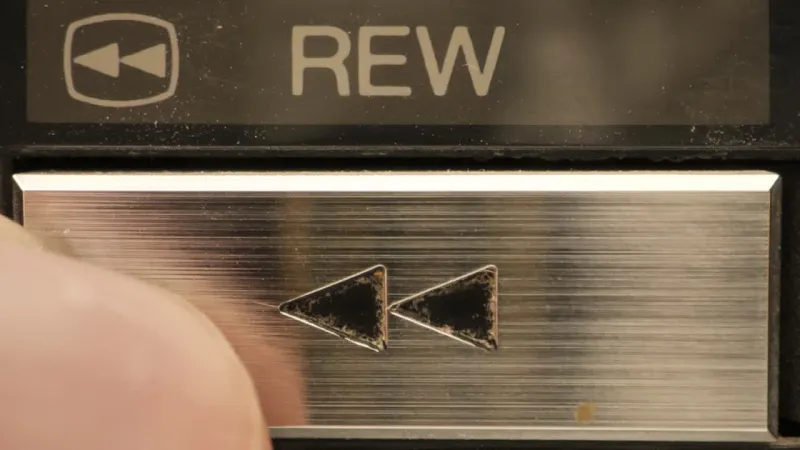
Photo: person pressing rewind button on VCR remote control close up vintage 1990s, via videocdn.cdnpk.net
There's a specific kind of memory that VHS created and streaming never will. It's not the memory of a whole movie — it's the memory of a moment. A two-second stunt. A line reading so perfectly weird it didn't make sense the first time. A special effect that looked fake and incredible at the same time. You watched it, your brain fired, and your hand reached for the remote before the next scene even started.
Rewind. Play. Rewind. Play.
You probably did this dozens of times without ever thinking about what it meant. But that little mechanical loop — that friction-filled ritual of magnetic tape spooling backward — was quietly building the architecture of how an entire generation would remember cinema.
The Button That Built an Obsession
Rewinding wasn't effortless. That's the part people forget. On a good VCR with a solid remote, hitting rewind and finding your spot took maybe fifteen seconds. On a cheap deck with a worn belt, you were overshooting and fast-forwarding back and overshooting again. You were working for that moment. And that effort mattered.
Psychologists who study memory have long noted that repetition and active engagement both strengthen recall. VHS handed viewers a tool that did both simultaneously. Every rewind was a vote — a physical declaration that this moment was worth the trouble. You weren't passively absorbing a film anymore. You were editing it in real time, selecting the scenes your brain decided to permanently file.
Think about the movies you watched on tape as a kid. Chances are you don't remember them scene by scene. You remember the moments. The chest-burster in Alien. The car flip in The Blues Brothers. The hallway fight in The Matrix — a film that practically came pre-loaded with rewind coordinates. These aren't just memorable scenes. They're scenes that survived the rewind test, scenes that held up under repeated scrutiny and kept delivering something worth going back for.
Shared Moments Before Sharing Existed
Here's the thing about rewind culture that almost nobody talks about: it was social long before social media existed.
Kids in the late '80s and '90s didn't have group chats. They had the school bus, the lunch table, and the backyard. And the currency of those conversations was often a very specific kind of question — did you see that part where...? Not did you see that movie. That part. The scene. The moment. The thing you rewound.
VHS created a shared vocabulary of fragments. You didn't need to have watched the same movie at the same time, or even in the same year. As long as you'd both worn a groove into the same scene, you had a connection. The rewind button was the original clip-sharing platform, except instead of sending a link, you invited someone over and physically showed them the tape.
Video stores understood this instinctively. The hand-lettered signs that clerks taped to the shelves — "The fight scene alone is worth it" — weren't describing films. They were describing moments. They were marking rewind coordinates for strangers.
Why Some Scenes Became Bigger Than Their Movies
Not every great film produced great rewind moments. And not every rewind moment came from a great film.
This is one of the stranger legacies of the VHS era: the format occasionally elevated a single scene above the reputation of the entire movie surrounding it. There are films from the '80s and '90s that almost nobody would describe as classics but that produced moments so rewind-worthy they've outlasted their source material entirely. B-movies with one spectacular practical effect. Comedies with a single improvised exchange so perfectly timed it still lands thirty years later. Action films where one stunt looked so genuinely dangerous that you kept going back to verify it was real.
Streaming hasn't been able to replicate this dynamic, and the reason is surprisingly mechanical. When you can pause, scrub, and skip with zero friction, you never actually commit to rewinding. You skim. The low cost of revisiting a moment means you revisit it casually, and casual repetition doesn't build the same kind of memory. The rewind button worked partly because it cost you something — even if that something was just thirty seconds and a little patience.
The Collector's Version of This Story
If you're someone who still hunts tapes, you already know there's a specific category of VHS that commands attention beyond its general rarity or condition: the tape that contains the scene. The copy of The Thing where the practical effects still look more disturbing than anything CGI has produced since. The Terminator 2 tape where you can actually see the film grain during the T-1000 sequences in a way that no digital transfer quite captures.
Collectors talk about these tapes the way music people talk about original pressings. It's not just nostalgia. It's an argument about fidelity — the idea that the version of a moment you first rewound might actually be the truest version of it, and that something gets lost in the conversion to clean, frictionless digital.
There's something to that. The grain and the tracking lines and the slight color bleed of a VHS transfer aren't just artifacts of an older format. They're part of the texture of the memory. When you watch a perfectly restored 4K version of a movie you first saw on tape, the scene is technically superior in every measurable way — and somehow feels slightly less like yours.
What We Were Actually Doing
Look back at the rewind habit and it's hard not to see something that looks a lot like the way we consume media now — just slower, louder, and more intentional. We were clipping before clipping existed. We were sharing before sharing was easy. We were building a personal canon of moments, scene by scene, rewind by rewind.
The difference is that the friction forced a kind of curation. You didn't rewind everything. You rewound what mattered. And in doing so, you made a decision — conscious or not — about what was worth remembering.
Streaming gave us everything. The rewind button gave us the discipline to choose.
Some of us are still choosing the same scenes we chose thirty years ago. And honestly? They still hold up.